Diwali (Deepavali in Sanskrit, meaning “row of lamps”) is one of India’s most loved festivals.
Origins as an Autumn Harvest Festival
Like many other Indian festivals, Diwali has regional variations and diverse stories associated with it, but there are some common pan-India elements that go back to its roots as an autumn harvest festival.
Around the world, agrarian communities have traditionally held celebrations around harvest seasons, and India is no exception. All the harvest seasons (spring, autumn, monsoon) in India are highly festive. The autumn harvest, typically occurring around October or November, is especially flanked on either side by two of the country’s biggest festivals.
Navaratri, which falls before the harvest, may originally have been a period of fasting and prayer when grain stores were low or depleted. On the other hand, Diwali, which falls soon after the harvest, is a joyous festival of abundance and renewal.
Diwali’s Religious Symbolism for Hindus
In Hinduism, God (Brahman) in its entirety is considered to be beyond our conception as humans. However, we can experience and conceptualize various aspects of God. For example, Brahma is the Creator, Vishnu is the Sustainer, and Shiva is the Destroyer, while Shakti (the Goddess) represents the energy that propels and drives creation.
The creative, sustaining, destructive, and propelling aspects of the Brahman are explained beautifully through stories and metaphors, often based on actual historical events.
Vishnu’s role as the sustainer, for instance, is illustrated through the stories of his avatārs (human incarnations), where he is instrumental in ensuring the victory of Good over Evil to restore morality and balance (dharma).
Meanwhile, the Goddess (Shakti) embodies many things – fertility and abundance (Lakshmi), motherhood (Parvati), fierce protectiveness of her children (Durga), and also wisdom, learning, and the arts (Sarasvati).
At its core, Diwali celebrates Vishnu, the God of sustenance, and Lakshmi, the Goddess of fertility and abundance.
Vishnu – The God of Sustenance
Vishnu’s origins go back to the Vedic Sun and Rain Gods, as both these elements of nature are key to sustaining life. However, as Hinduism evolved, the concept of Vishnu as sustainer became more complex in line with society’s increasing complexity.
The story of two of Vishnu’s later avatārs, Rama and Krishna, for instance, are told in the Ramayana and the Mahabharata. These are epic poems too long and complex to describe here, but both relate many episodes of the destruction of evil forces to restore morality (dharma). Diwali celebrates two of these episodes in particular.
One is Krishna’s killing of Narakasura, the demon king who had abducted and imprisoned 16,000 women. Narakasura is said to have been Krishna’s own son from a previous avatār, and his killing by Krishna symbolizes Vishnu’s role in preserving dharma at all costs.
The other episode is from the Ramayana, where the people of Ayodhya are described as celebrating joyously by lighting rows of lamps when their beloved prince, Rama, returns home after defeating the demon king Ravana.
Ravana, again, was a notorious sexual predator who had abducted Rama’s own wife (Sita) in addition to many other women, and his killing was necessary to preserve the fabric of society.
Lakshmi – The Goddess of Wealth
Many people have a superficial understanding of wealth as money or gold, but true wealth encompasses much more than that. The word “wealth” itself relates to much broader concepts like “wellness” and “well-being.”
Health, beauty, nourishment, progeny, family, community, knowledge, and the rule of law are all facets of wealth, and all of them are duly honored and invited into one’s life during Diwali.
The History and Evolution of Diwali
The roots of most Indian festivals stretch back thousands of years.
Mentions of rituals and celebrations around the autumn harvest appear as early as the Rigveda (pre-1500 BCE), and celebrations involving rows of lamps on the new moon day in the month of Kartik are described in many ancient texts from the first millennium BCE.
However, it was during the first millennium CE, a period of Hindu cultural renaissance, that many of our festivals acquired their contemporary form.
The Purāṇas, a set of 36 encyclopedic texts composed during this period, contain a wealth of historical, mythological, cultural, religious, geographic, and other information about the Indian subcontinent in those times. It is in these texts that we find the earliest detailed accounts of a five-day Diwali celebration closely resembling what we have today.
The Five Days of Diwali
The main day of Diwali falls on the new-moon day of the lunar month of Kartik (typically sometime in October or November in the solar calendar). But the two days before and two days after are also part of extended Diwali celebrations.
Dhanteras – Praying for Good Health
The first day of Diwali is Dhanteras, which honors Dhanvantari, the God of Ayurveda and good health. People clean and decorate their homes on this day to prepare for a new beginning by sweeping away accumulated impurities.
Dhanvantari puja (worship) is typically performed in the evening, with offerings of medicinal herbs. In North India, traditional offerings include a kalash (pitcher) filled with holy water, symbolizing the nectar of immortality, along with holy basil, herbs, spices, gold coins, and brass utensils. In Maharashtra, the traditional offering is coriander seeds lightly pounded with jaggery. In South India, there is a long tradition of preparing an Ayurvedic tonic with digestive and immunity-boosting properties called Dīpāvalī legiyam (लेह्य).
Another tradition is the lighting of Yama Dīpam in the evening. A set of 13 oil lamps (diyas) are lit and placed facing south to propitiate Yama, the God of death, in order to ward off untimely death.
Though originally unrelated to Dhanvantari or Dhanteras, the word “dhan” also means wealth in Sanskrit. This has given rise to a tradition, especially in North India, of shopping for major items on Dhanteras day. People consider it auspicious to buy gold, kitchen utensils, and durable goods on this day, turning it into a big commercial holiday in recent times, with attractive sale offers and markets filled with shoppers.
Narakachaturdashi – Celebrating the Victory of Good Over Evil
The second day of Diwali commemorates Krishna’s slaying of the demon king Narakāsura, symbolizing the triumph of good over evil and the restoration of dharma.
Returning home covered in the demon’s blood, Krishna was lovingly welcomed with an Ayurvedic oil massage (abhyanga) and exfoliating bath (ubtan snaan) to wash away the taint and weariness of battle.
The Harivamsa (appendix to the Mahabharata) says that Krishna killed Narakasura in the early morning hours, so people across India celebrate this day by waking up before sunrise for an oil-massage and bath, after which they don new clothes.
This is seen as a cleansing and beautifying ritual to prepare the body as a temple and be receptive to Lakshmi’s grace.
Firecrackers are also burst on this day to reenact the battle between Krishna and Narakasura.
Deepavali and Lakshmi Puja – Inviting Prosperity and Well-Being
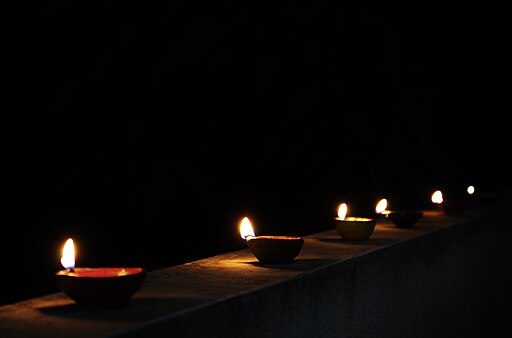
The new moon day of Kartik is the main day of Diwali for most of India. As night falls, homes across the country are illuminated by rows of earthen oil lamps (deepāvali) placed on windowsills and terraces.
The lamps symbolize the victory of good over evil and knowledge over ignorance – both of which are necessary for inviting the wholesome presence of Lakshmi into one’s life.
Colorful rangoli designs adorn floors, courtyards, and entranceways, featuring auspicious symbols like swastikas, lotuses, and Lakshmi’s footprints. Doors and windows are kept open to welcome the Goddess.
Lakshmi puja is performed in the evening, with ārti (ritual offering of light) and hymns. Some families also perform pujas to Rama and Ganesha (the God of auspicious beginnings).
As a post-harvest festival of abundance, feasting is an important part of Diwali. Keel-batāshā (puffed new rice and sugar candy) or laddus made with puffed new rice and jaggery are highly traditional Diwali offerings that preserve an ancient memory. A large variety of other sweet and savory delicacies are also made and shared with family and friends.
Diwali night is marked by boisterous celebrations with firecrackers, sparklers, spinners, fountains, and other small-scale fireworks.
Govardhana Puja, Gorehabba – Honoring Cattle as a Form of Wealth
Govardhan is the name of a hill near Vrindavan, about two hundred kilometers south of Delhi. Krishna is said to have grown up in Vrindavan as a cowherd, grazing his cattle in its forests and on Govardhan hill.
In a famous episode from Krishna’s childhood, he institutes the worship of Govardhan hill as the provider of nourishment for cattle, which are an important form of wealth historically and even today.
The word “govardhan” derives from go (cow/cattle) + vardhan (increase/growth), so Govardhan puja on the fourth day of Diwali honors cattle and prays for their welfare.
A play on “go-vardhan” is “gobar-dhan,” which translates to “cow-dung wealth.” Cow dung is an extremely important part of the rural economy. It is composted and used as organic manure to fertilize fields. Dried cow dung patties are used as fuel in rural households. Fresh cow dung, which has beneficial microbes exhibiting antimicrobial and antifungal properties, is used as a pesticide and also to wipe the floor in mud huts, both to settle the dust and to sterilize the living environment.
Govardhan puja is performed by making small dung heaps or sculptures, with the whole family gathering around to show their gratitude for cattle and all the benefits obtained from them, right down to their dung. This puja is of special significance to rural and cattle-herding communities even today.
In many parts of south India, the same day is celebrated as Gorehabba, where locals collect fresh cow dung and engage in a fun dung-flinging fight. As cows are herbivores, their dung has an earthy, grassy odor and a significantly reduced risk of human pathogens.
Science shows that cattle-herding communities often exhibit remarkable gut microbiome diversity and lower rates of certain inflammatory/Western diseases, likely due to exposure to beneficial microbes from cattle and dung.
Bhai Duuj – Cherishing Sibling Ties and Family
The Rigveda tells the story of primordial twin siblings Yama (the brother) and Yami (the sister) in the form of a dialogue between them. Yami urges her brother to procreate with her, but Yama explains to her that this is against the natural order.
Yama goes on to become the first mortal being. The Rigveda describes him as “the first to attain death, pioneering the path to the afterlife.” Yami, for her part, is described in later texts (the Purāṇas) as having become the river Yamuna, perhaps symbolizing the flow of life in contrast to her brother.
Once, on the second bright day of the Kartik month, Yami longed to see her brother and prayed for a visit. Yama answered her prayer by traveling from the netherworld and was received with great affection and hospitality.
In honor of their bond, Yama blesses siblings who renew their ties on this day by protecting them from untimely death. This is the fifth day of Diwali, called Yama Dvitiya or Bhai Duuj. On this day, brothers visit their sisters, who welcome them with affection and hospitality and pray for their long lives. Brothers reciprocate with gifts and promise protection.
In many societies, women leave their natal villages after marriage, but festivals like Bhai Duuj, which celebrate the brother-sister bond, give them an opportunity to reconnect with their families, keeping those relationships strong.
Not Just a Hindu Festival
Apart from Hindus, Jains and Sikhs also celebrate Diwali as a religious festival symbolizing dharma and enlightenment.
In Jainism, Diwali is observed as the day on which Mahavira, the 24th Tirthankara of Jainism, attained nirvāna (liberation from the cycle of birth and death) at Pavapuri in 527 BCE.
In Sikkhism, Diwali is observed as the day commemorating the release of the sixth Sikh Guru, Guru Hargobind, from the Gwalior fort, where he was imprisoned by the Mughal emperor Jehangir.
While Hinduism, Jainism, and Sikhism all commemorate events important in their own respective traditions to celebrate Diwali, the underlying religious symbolism (celebrating light, knowledge, and morality over darkness, ignorance, and immorality) and cultural practices (lighting lamps, decorating homes, exchanging sweets) are very similar in all three traditions.
Other Harvest Festivals
India is a vast country with multiple climate zones, so different regions have slightly different harvest seasons.
For instance, Tamil Nadu’s biggest harvest is in January, and it is celebrated grandly as Pongal over the course of four days – Bhogi Pongal (a day of cleaning), Thai Pongal (honoring the Sun God and celebrating a bountiful harvest), Māttu Pongal (honoring cattle), and Kānum Pongal (honoring the brother-sister relationship and broader family ties).
Diwali in Tamil Nadu is a two-day festival, mainly restricted to Dhanteras and Narakachaturdashi, but celebrations and rituals strikingly similar to Diwali are observed during Pongal instead.
Pongal is also celebrated in other parts of the country as Khichdi, Lohri, Sankrānti, Uttarāyan, Māgh Bihu, and Ghughutiyā – a solar festival signifying the end of winter.
In Kerala, the main harvest is during the monsoon, and this is celebrated on a grand scale as Onam, over the course of 10 days.
More about these and other festivals in another blogpost!
Leave a Reply